Steer-by-Wire: Mercedes EQS innovation or an expensive leap of faith?
Mercedes-Benz's adoption of steer-by-wire in the EQS, eliminating the mechanical link to the wheels, promises radical handling but forces us to re-evaluate what true driving connection means.
Photo: Jonathan Weiss / Shutterstock.com
In an era of rapid automotive evolution, is a fundamental redesign of the steering system a daring stroke of genius or an unnecessary complication? Mercedes-Benz is betting on the former, launching its true steer-by-wire technology in the 2027 EQS, a move that redefines the very act of turning a wheel.
This technology, which will cost customers an additional €2,975 in Germany, entirely removes the physical connection between the steering wheel and the front wheels. Instead, electronic signals translate driver input into steering action, allowing for a mere 170 degrees of wheel rotation from lock to lock. This radical departure promises a new level of driving comfort and precision, but it inevitably sparks debate about tradition, control, and the perception of safety.
The Promise of Effortless Precision
The most immediate and compelling argument for steer-by-wire lies in its potential to transform the driving experience, especially in a large luxury sedan like the EQS. With an infinitely variable steering ratio, the system dynamically adjusts how much the wheels turn based on speed and driving mode. At low speeds, maneuvers like parking or three-point turns become notably easier, demanding minimal steering input and eliminating the "bus driver hand-shuffling" you might expect in a large luxury sedan. The system allows the nose to react with an "absurdly alert" speed that can initially surprise, making the front end feel sharp and impatient. This responsiveness contributes to an easier driving experience, significantly reducing the effort required for maneuvers and turns.
This shift in feel is profound; a conventional EQS, when driven back-to-back, immediately feels older, requiring more arm work and offering slower responses. Mercedes-Benz claims less lag than a conventional solution, with a one-millisecond delay, and uses two electric motors to simulate feedback, enhancing the sense of connection that might otherwise be lost.
Redundancy and the Road Ahead
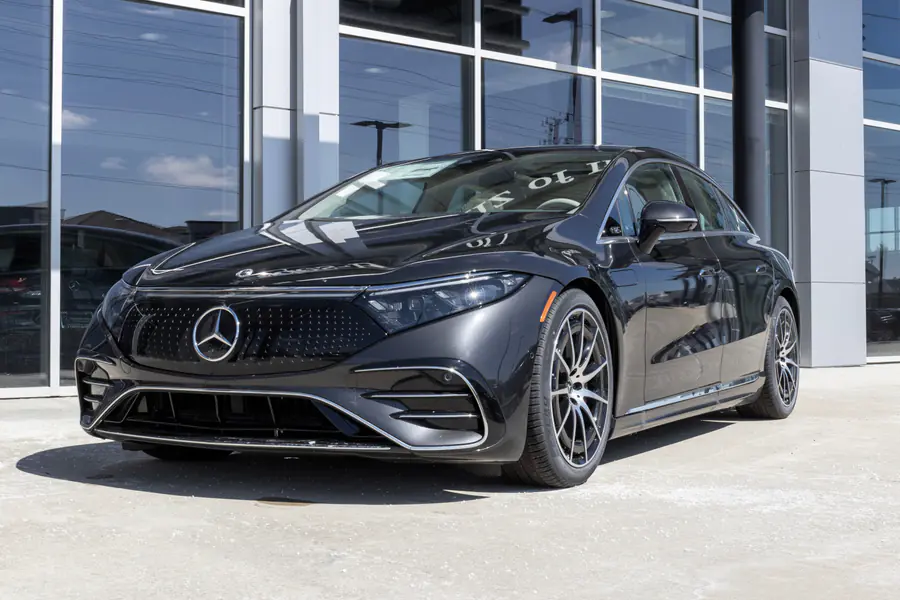
While the concept of an electronic steering link might raise concerns about safety, Mercedes-Benz has engineered its system with extensive redundancy. The first iteration of steer-by-wire in a production car, the 2014 Infiniti Q50, retained a mechanical safety net. However, Mercedes-Benz, following the path of the Tesla Cybertruck and Nio ET9, has eliminated this physical shaft in its 2027 EQS, becoming the first German automaker to do so. To ensure reliability, the Mercedes system features dual DC-DC converters, separate power supplies, two communication circuits, and steering motors with two independent stator windings. The Nio ET9 and Mercedes-Benz also utilize distinct CPUs, software, and hardware to prevent common failure points, and incorporate a third set of steering angle sensors, an aerospace protocol, to verify input accuracy. Both systems are safety certified by their national governing bodies.
In the unlikely event of an error, the EQS enters a limp-in mode, limiting speed to 54 mph and allowing a driving distance sufficient to exit Norway's 15.2-mile Laerdal Tunnel. Should both primary systems fail simultaneously, the vehicle can maintain the driver's intended path by utilizing rear-wheel steering and selective braking. This level of engineering, mirroring aerospace protocols, underscores Mercedes-Benz's commitment to safety in this radical new direction, challenging perceptions of what a connected driving experience truly means.
No topics yet: start the first one.