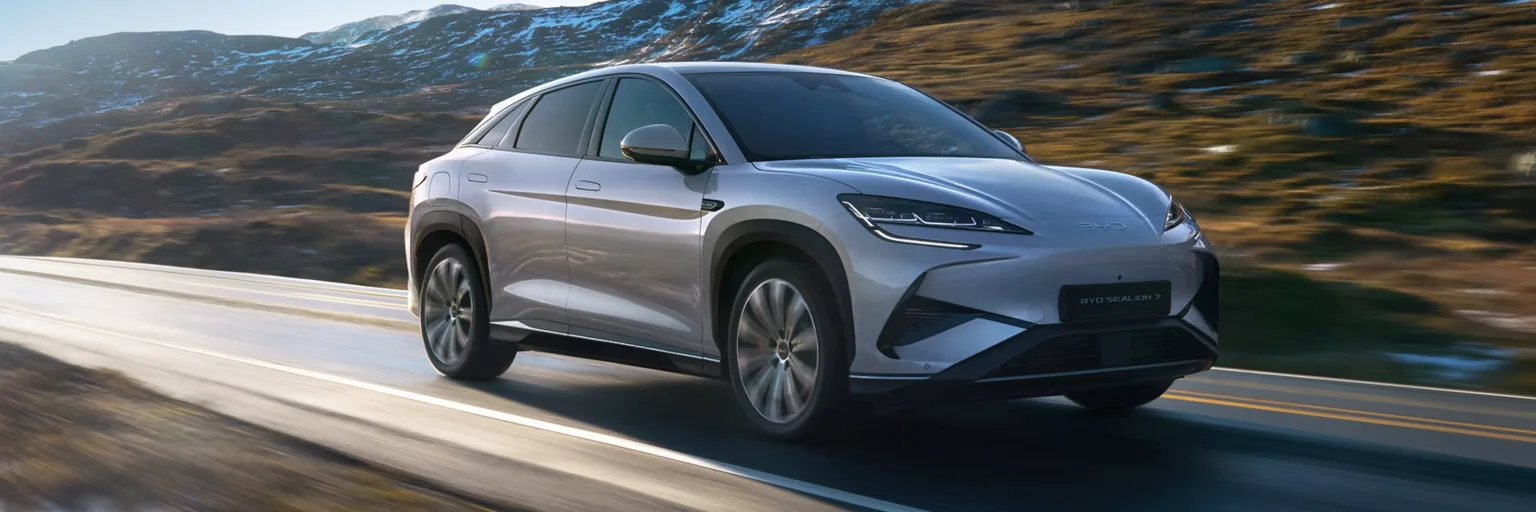
BYD's European factories are the real answer to EU tariffs, and a local fight
Tariffs and hybrid quotas are pushing BYD to build in Europe. Buyers and workers may gain, but the trade war now moves inside EU borders.
Photo: BYD / sala de prensa (uso editorial)
What do you do when a wall goes up around your biggest growth market? If you are BYD, you move to the other side of it. The tariff fight that was supposed to protect European carmakers is turning into the strongest argument for Chinese carmakers to become European ones.
Brussels built a wall, and BYD is building around it
As the South China Morning Post reports, BYD is set to build new factories in Europe to combat trade barriers aimed at Chinese EVs. The trigger is the EU's announcement in mid-October that it would impose a quota on hybrids imported from China, which the SCMP puts as high as 45.3 per cent. Reuters reported that China's hybrid exports to the EU tripled to $7.5 billion in the first half of 2026, after tariffs hit Chinese-made EVs.
Details are still murky. Trade press noted that it is unclear whether the EU and China agreed on a hard cap of 350,000 units or something looser. We would treat any precise number on the quota with caution for now.
Tariffs didn't stop BYD, they redirected it
Think of the sequence. The EU taxed Chinese-built EVs, so Chinese brands leaned on hybrids, which sat outside the heaviest duties. Now hybrids get a quota. Each barrier has produced a workaround, and the workaround is getting heavier and more permanent: concrete and steel rather than shipping containers.
The flagship is Szeged, Hungary. According to newsauto.it, series production is planned for the fourth quarter of 2026, starting with the Dolphin Surf, the European version of the Seagull. Initial capacity is put at 150,000-200,000 vehicles a year. BYD is also weighing a second European site, with Spain and France among the destinations considered, and possibly a battery plant. Cars built inside the EU avoid the import duties on Chinese-made EVs, which is the whole point.
In our view, this is the logical endpoint of a tariff strategy that targeted the product and not the producer. You can tax a container ship. It is much harder to tax a factory employing local workers, especially when governments compete for that factory.
Buyers and workers probably win, at least at first
The upside looks real. Local production lets BYD hold prices without the duty penalty, and the same sources describe a company that wants to go from roughly 10,000 European employees to more than 40,000 by 2030. That is a target, not an achievement, and it depends on sales and ramp-up. But other carmakers in Europe are restructuring, closing plants and cutting staff, so a rival hiring is not a small thing.
For shoppers, more supply of small electrified cars from a company with a deeply integrated supply chain probably means pressure on prices. That pressure is also what worries incumbents. We think the likely winners are urban buyers who have been priced out of small EVs, and the likely losers are European makers who relied on tariffs to buy time rather than on cheaper cars.
The trade fight is now a local one
Here is the catch. Once BYD employs thousands in Hungary, the question stops being "Brussels versus Beijing." It could easily become one country against another, Spain versus France for the next plant, and unions versus governments over who gets the investment. Reuters, as relayed by Alvolante, reported in 2025 that Germany, opposed to the tariffs, was favored for a third plant, while Italy and France, which backed them, were reportedly less likely. That was a report, not a decision, but the logic is telling: tariff politics may now shape where the jobs land.
That risks fragmenting European industrial policy. A bloc that sets common duties but lets members court the very companies those duties target is arguing with itself. And "assembly" is not the same as "European." Screwdriver plants that import key components add jobs but little local industry, so the real test is how much of the supply chain BYD localizes.
Our verdict
Tariffs didn't fail so much as change the battlefield. If Brussels wants the benefits of Chinese investment, it should set local-content and technology-transfer expectations rather than keep chasing each new workaround with a new quota. If you are a buyer, we would expect more choice and lower prices in the coming years, probably. If you work for a European carmaker, the lesson is uncomfortable: the competitor is no longer overseas.
No topics yet: start the first one.
More stories
Audi's Georgia plant is a tariff hedge, not a victory lap
Audi's $4 billion US factory answers tariffs and politics first. It only becomes good news for American buyers if it brings lower prices and SUVs built for them.
Stellantis' 24 full hybrids are pragmatic, but also a late admission
Stellantis' pivot to 24 full hybrids by 2030 shows realism after years of zigzagging on EVs, but it risks arriving late. Buyers should wait for real efficiency numbers.
Volvo's plants building Geely cars is smart, but only if Sweden stays visible
Letting Geely's premium brands use Volvo's European factories from 2028 should cut costs and dodge tariffs, but it makes brand discipline Volvo's most urgent job.
Chinese EVs don't need to be perfect, just much cheaper
A Chinese discount of about 40%, if it holds, exposes a Western defense built on tariffs and brand loyalty that is thinner than it looks.