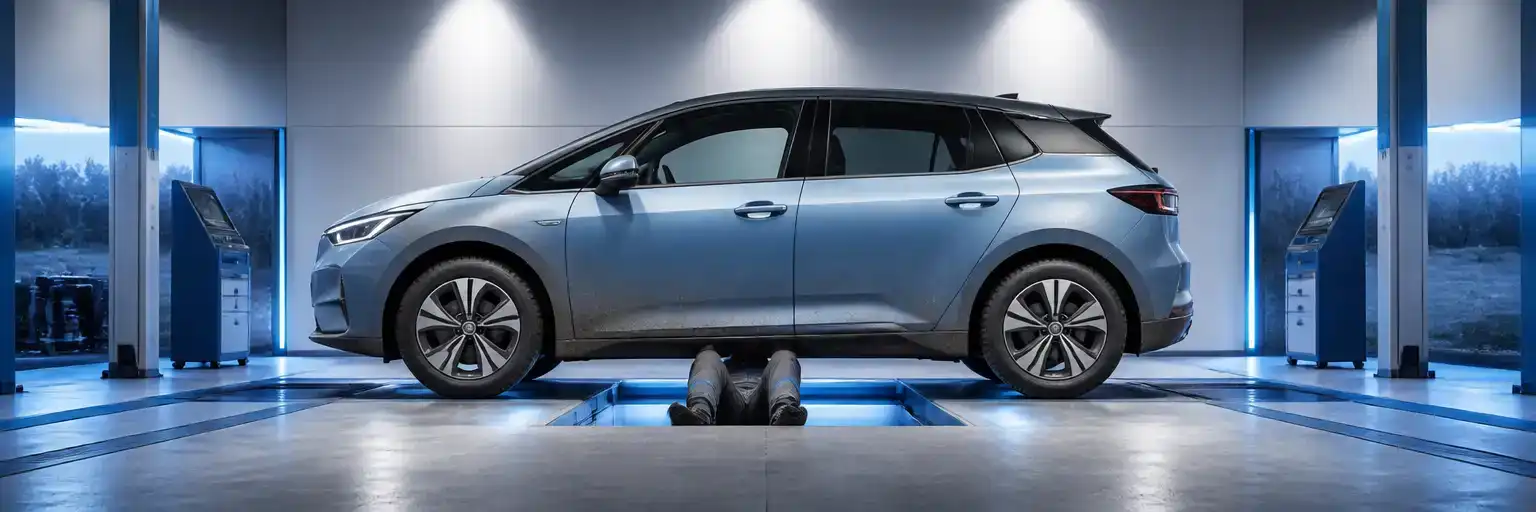
Svolt's semi-solid pack proves you can skip the wait, not the proof
Svolt's mass-produced 100-kWh Dragon Armor pack shows semi-solid is a real shortcut. The 12-minute and million-km claims are still marketing until independent data shows up.
AI-generated image
For years the electric car industry has told us to wait for solid-state batteries, the "definitive" cell that will fix range, safety and charging in one stroke. Svolt just suggested a different plan: stop waiting and ship something in between. The question is whether the in-between product is as good as its press release.
On October 26, 2026, Svolt announced that the first batch of its 100 kWh Dragon Armor semi-solid packs had rolled off the line in Changzhou. CnEVPost reports that the line is in Jiangsu province. The company claims a 900-volt architecture and 6C charging, good for 500 km of range in 12 minutes. The EV Report converts that to 311 miles, which is the number US readers will care about.
Spanish outlet Motor.es goes further and headlines a promise of one million kilometers. The snippets we have don't say how that figure was derived, and that gap is the whole story.
The production line is the real news, not the brochure numbers
Pilot cells and lab records are cheap. Packs coming off a production line are not. Svolt is a battery maker that became independent in 2018 but, as CarNewsChina notes, it remains tightly tied to GWM as a core supplier. In our view, that backing makes a production start more credible than a startup's render. One caveat: a first batch tells us nothing about volume, and the documentation doesn't say how fast the line will ramp.
The technology itself is also a pragmatic one. Arena EV describes a hybrid design that uses three chemical systems, which Svolt believes is the long-term technological path. We read that as an admission that the industry's fully solid cell is not the only door to better batteries. If the claimed charging speeds hold up, a semi-solid pack you can build today could beat a perfect cell that arrives later. This is the underrated lesson: the best battery is often the one you can build at volume.
Meanwhile, the all-solid camp is still looking at trials. CarNewsChina's headline says CATL is advancing 20 Ah solid-state cells ahead of 2027 trial production. Trial production in 2027 is not a car in your driveway.
"12 minutes" and "a million km" are claims, not data
Here we put the brakes on. The outlets repeating the 12-minute figure present it as the company's claim. One of them, DriveAgent, adds the detail that matters most: no customer vehicle has been named. A battery with no car is a component, not a product you can buy.
That omission changes how to read the numbers. "500 km in 12 minutes" depends on the vehicle's efficiency, the starting state of charge, the temperature and the charger. A 900-volt, 6C pack also needs a charger that can feed it, and nothing in our documentation says where those will be. Lifetime is even harder. A million kilometers is a claim about decades of use, and a pack that only just started production can't have proven it in the field. We suspect it is an extrapolation from lab cycling, but we'd call it a forecast until someone shows the test protocol, the degradation curve and the conditions.
Don't buy anything on the strength of a press release
If you're a buyer, nothing changes yet. Don't wait for a Svolt-powered car that nobody has announced, and don't discount today's lithium-ion packs on the basis of a press release. If you follow the industry, watch for three things: a named automaker, a published test report from an independent lab, and real charging curves from a production car.
Our verdict: Svolt has earned credit for getting a semi-solid pack into production, and that does weaken the "wait for solid-state" narrative. It hasn't earned credit for the headline numbers. Until independent data arrives, treat 12 minutes and a million kilometers as the brochure, not the spec sheet.
No topics yet: start the first one.
More stories
Used Chinese EVs at 40% off are a real loophole, not a free lunch
French buyers are exploiting a gap in EU tariffs to import near-new BYD and Xiaomi EVs. The discount is real, but the paperwork and the unknowns may eat the savings.

Stellantis' LFP switch is the right fix for cheap EVs, just late
Moving European EVs to cheaper LFP cells in 2027 attacks the real cost problem, but the timing and the unquantified trade-offs deserve skepticism.
The UK's per-mile EV tax is fairer than a flat fee, if it gets three things right
Britain's pay-per-mile EV tax could become a template for other countries, but it only works if privacy is airtight, the price per mile is transparent and early adopters aren't punished.
The used-EV reliability scare is running out of evidence
A UK analysis of 47.4 million inspections suggests high-mileage EVs fail less often than petrol cars. The mileage fear looks like the wrong number to worry about.